2“抗炎饮食”走红!抗炎食物和促炎食物都有啥?
Meet your team of GI specialists and dietitians
认识您的消化道专家和营养师团队
Anti-inflammatory foods have antioxidant properties, which means they fight inflammation in your body and help reduce your risk for several chronic diseases. They can also be a helpful tool in your arsenal if you’re managing a gastrointestinal (GI) condition. What are some of the top anti-inflammatory foods? Fruits and veggies, nuts and seeds, fatty fish, and coffee and tea—to start.
抗炎食品具有抗氧化特性,这意味着它们能抵抗体内炎症,帮助降低多种慢性疾病的风险。如果你正在管理胃肠疾病,这些工具也可以成为你的宝库中有用的工具。有哪些顶级的抗炎食物?水果和蔬菜、坚果和种子、肥鱼,以及咖啡和茶——先从中开始。
Ready to reduce your inflammation? Work with registered dietitians and GI specialists for sustainable relief.
准备好减少炎症了吗?与注册营养师和胃肠专家合作,实现可持续的缓解。
Whenever I think of the word “inflammation,” I picture the fire emoji on my phone. Inflammation is the way your body signals that something is wrong, and it causes the immune system to jump into action. Think of it this way: If your house is on fire, you call the fire department to put the fire out. But we can take several steps to avoid or lessen the chance of a fire in the first place and to counteract the blaze if one ignites. Anti-inflammatory foods can be both your first responders and your preventive measures.
每当我想到“炎症”这个词,我就会想象手机上的火焰表情符号。 炎症是身体发出异常信号的方式,促使免疫系统迅速行动。这样想:如果你的房子着火了,你会打电话叫消防队去灭火。但我们可以采取多种措施,避免或减少火灾发生的可能性,并在火灾发生时进行反制。抗炎食品既可以是你的第一响应者,也可以是预防措施。
The typical Western diet—which is full of ultra-processed foods, added sugar, and additives that boost flavor and shelf life—can cause inflammation in our bodies. And that inflammation, particularly when chronic, can wreak havoc on our gastrointestinal (GI) health. The good news? It’s pretty easy to tweak your diet to include some of the best anti-inflammatory foods out there—those that help support GI health, reduce symptoms, and lead to better overall health. Plus, they’re delicious to boot.
典型的西方饮食充满了超加工食品、添加糖和添加剂,这些添加剂能提升风味和保质期, 可能会引发体内炎症 。而这种炎症,尤其是慢性炎症,会严重影响我们的胃肠道健康。好消息是?调整饮食,加入一些最好的抗炎食物其实很容易——那些有助于支持胃肠健康、减轻症状并促进整体健康的食品。而且,它们非常美味。
In this article, we’ll explore what inflammation is, how to build an anti-inflammatory diet, and which foods to reduce or eliminate if you want to keep inflammation in check.
本文将探讨什么是炎症,如何制定抗炎饮食,以及如果你想控制炎症,应减少或淘汰哪些食物。
How inflammation affects the body
炎症如何影响身体
The first thing to know about inflammation is that it isn’t always a bad thing. It does get a bad rap for its connection to chronic diseases, such as inflammatory bowel disease (IBD), arthritis, and more. But inflammation in the short term—aka “acute inflammation”—helps keep your body safe.
关于炎症,首先要知道的是,它并不总是坏事。它因与慢性疾病(如炎症性肠病)、关节炎等相关性而声名狼藉。但短期内的炎症——也就是“急性炎症”——有助于保护你的身体安全。
For example, not too long ago, I ever-so-gracefully slipped on a rain-soaked curb, fell, and skinned my knee while walking to a show. Later, my knee was swollen and red as my body tried to repair the issue and ward off infection. That redness was the result of inflammation kicking off a multi-step process involving my immune system. This includes four superhero-like tasks.
比如,不久前,我优雅地在雨水浸湿的人行道上滑倒,摔倒了,膝盖擦伤了。后来,我的膝盖肿胀发红,身体试图修复问题并防止感染。那种发红是炎症引发了我免疫系统多步骤的过程 。其中包括四个类似超级英雄的任务。
Acute inflammation process
急性炎症过程
- Irritation is the alarm signal that helps recruit white blood cells to the affected area—they’ll help with protection and repair.
刺激是警戒信号,帮助招募白细胞到受影响区域——它们有助于保护和修复。 - Amplification involves the release of chemicals that recruit additional types of white blood cells to ramp up the fight. Think of the process as an army bringing in more troops.
扩增是指释放化学物质,招募更多类型的白细胞以增强战斗强度。把这个过程想象成一支军队增援。 - Destruction is when the immune system does its job to neutralize (calm) the injury—and remove debris or bacteria that could cause an infection.
破坏是指免疫系统发挥作用,中和(平息)伤口,并清除可能导致感染的杂质或细菌。 - Termination is the release of chemical substances to chill out the inflammatory process before damage can occur.
终止是指释放化学物质以冷却炎症过程,防止损伤发生。
As you can see, the acute inflammatory process occurs to help quickly fix a bodily issue—like my skinned knee, a tweaked elbow from a heated game of pickleball, or even a bout of the seasonal nasties, such as the flu or common cold. But chronic inflammation—which is ongoing and becomes problematic—can also occur because of inflammation overload.
正如你所见,急性炎症过程是为了帮助快速修复身体问题——比如擦伤的膝盖、激烈的皮克球比赛中扭伤的肘部,甚至是流感或普通感冒等季节性疾病。但慢性炎症——持续存在且成为问题——也可能因炎症过载而发生。
Get clinically-proven GI care—from almost anywhere
几乎在任何地方获得经过临床验证的胃肠护理
Oshi Health is in-network with most major insurance
Oshi Health 与大多数主要保险公司均处于网络内
Check your coverage 检查你的保险覆盖范围
Chronic inflammation 慢性炎症
With chronic inflammation, the immune system can’t get us through all four of the acute phase steps. Instead, we get stuck in the irritation and amplification phases, because the immune system is having trouble managing its inflammatory load.
慢性炎症时,免疫系统无法让我们完成四个急性阶段。相反,我们会陷入刺激和放大阶段,因为免疫系统难以管理其炎症负荷。
Think of it as if you’ve got two teams playing a game in your body. If the pro-inflammatory processes team is outperforming the anti-inflammatory processes team, then chronic inflammation wins out. The anti-inflammatory team you’re rooting for isn’t going to get the trophy.
可以把它想象成你体内有两支球队在玩一场游戏。如果促炎过程团队的表现优于抗炎过程团队,那么慢性炎症就会胜出。你支持的抗炎球队不会拿到奖杯。
Chronic inflammation can occur for multiple reasons, including exposure to toxins (such as pollution, tobacco use, or problematic bacteria and fungi) or from a pro-inflammatory diet.
慢性炎症可能由多种原因引起,包括接触毒素(如污染、烟草使用或问题细菌和真菌)或促炎饮食。
What can we do? 我们能做什么?
One of the best ways to combat inflammation and all its symptoms is to eat a well-balanced and diverse diet, full of a variety of fruits, vegetables, nuts/seeds, grains, legumes, and lean protein sources. This helps support the immune system, maintains healthy cholesterol and glucose levels, and more.
对抗炎症及其所有症状的最佳方法之一是均衡多样的饮食,富含各种水果、蔬菜、坚果/种子、谷物、豆类和瘦蛋白来源。这有助于支持免疫系统,维持健康的胆固醇和血糖水平,还有其他好处。
The science behind anti-inflammatory foods
抗炎食品背后的科学
Anti-inflammatory foods have antioxidant properties. The term “antioxidant” gets thrown around a lot as a good-for-you thing. But what does it mean? Antioxidants scavenge (counteract) some of the unstable molecules, called free radicals, that can cause trouble in our bodies.
抗炎食品具有抗氧化特性。“ 抗氧化剂 ”这个词经常被当作有益的东西被提及。但这意味着什么?抗氧化剂会清除(抵消)一些不稳定分子,称为自由基 ,这些分子会在我们体内引发问题。
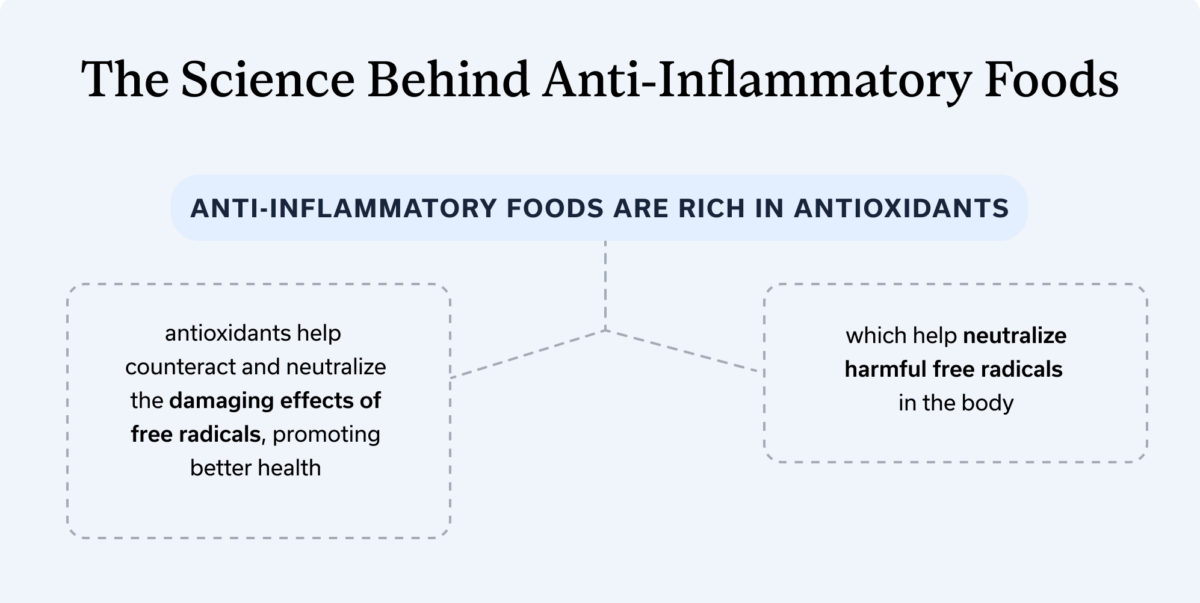
Our cells produce byproducts when they perform their usual functions—for example, converting the foods we eat into usable energy called adenosine triphosphate (ATP). Free radicals are some of those byproducts, and they can be bad for us when they build up. (After all, they are unstable molecules that can cause damage.) Free radical types include reactive oxygen species (ROS) and reactive nitrogen species (RNS).
我们的细胞在执行正常功能时会产生副产物——例如将我们吃的食物转化为可用能量,称为三磷酸腺苷(ATP)。 自由基就是这些副产物之一,当它们积累时对我们有害。(毕竟,它们是不稳定分子,可能造成损伤。)自由基类型包括活性氧(ROS) 和活性氮(RNS)。
When we have too many free radicals and not enough antioxidants to keep free radicals in check, we develop oxidative stress, which is a huge contributor to chronic diseases. Oxidative stress can damage our DNA and lead to conditions such as cancer, cardiovascular disease, type 2 diabetes, and neurological disorders. Oxidative stress also contributes to the development of GI conditions, including IBD, and it can disrupt the enteric nervous system (ENT), which is responsible for controlling GI functions.
当我们自由基过多而抗氧化剂不足以控制自由基时,就会产生氧化应激,而氧化应激是慢性疾病的重要原因。 氧化应激会损害我们的 DNA,导致癌症、心血管疾病、2 型糖尿病和神经系统疾病等疾病。氧化应激还会促成胃肠道疾病的发展,包括炎症性肠病(IBD),并可能干扰肠神经系统(ENT),而肠神经系统负责控制胃肠功能。
To make this easier to visualize, I like to think of the old-school game Pac-Man. He’s got to munch on a bunch of mini dots while avoiding four ghosts, right? Think of the mini dots as food in general and the ghosts as free radicals. But remember: The game also has larger dots called “Power Pellets” that give Pac-Man special powers. If Pac-Man eats the Power Pellets, the ghosts turn blue, and Pac-Man can then eat them instead of avoiding them. Basically, anti-inflammatory foods are your Power Pellets. We want to prioritize them as much as possible to counteract those blue-ghost free radicals.
为了更容易想象,我喜欢把老派游戏《吃豆人》想象成那样。他得一边吃一堆小点,一边躲避四个鬼魂,对吧?把小点看作食物,幽灵则是自由基。但请记住:游戏中还有更大的点,称为“能量圆珠”,赋予吃豆人特殊能力。如果吃豆人吃了能量丸,鬼魂会变成蓝色,吃豆人就可以吃掉它们,而不是躲避它们。基本上,抗炎食品就是你的能量丸。我们希望尽可能优先处理这些药物,以抵消那些蓝色幽灵自由基。
Compounds in food that act as antioxidants
食物中具有抗氧化作用的化合物
Carotenoids give plant foods their yellow, orange, and red pigments, and some can be converted into Vitamin A. Foods with carotenoids include carrots, some types of squash, and certain peppers.
类胡萝卜素赋予植物食物黄色、橙色和红色色素,有些还能转化为维生素 A。含类胡萝卜素的食物包括胡萝卜、某些类型的南瓜和某些辣椒。
Polyphenols are compounds that are powerhouses at combating oxidative stress. They include the following types.
多酚是抵抗氧化应激的强大化合物。它们包括以下类型。
- Coumarins are a type of polyphenol found in cinnamon and the stems, roots, and leaves of certain plant foods. Coumarins have neuroprotective properties, meaning they benefit your central nervous system.
香豆素是一种多酚,存在于肉桂以及某些植物食品的茎、根和叶子中。香豆素具有神经保护特性,意味着它们有益于你的中枢神经系统。 - Flavonoids are plant compounds that have anti-diabetic, anti-cancer, neuroprotective, and overall anti-inflammatory properties. There are various types of flavonoids: anthocyanins, flavan-3-ols, flavanols, flavones, flavanones, and isoflavones. Say that five times fast!
类黄酮是具有抗糖尿病、抗癌、神经保护及整体抗炎特性的植物化合物。类黄酮有多种类型:花青素、黄烷-3-醇、黄酮、黄酮、黄酮和异黄酮。快说五遍!- Anthocyanins are pigments in red, blue, and purple berries, and purple grapes.
花青素是红色、蓝色和紫色浆果以及紫色葡萄中的色素。 - Flavan-3-ols are most common in tea, cocoa, berries, grapes, and apples.
氟拉凡-3-醇在茶、可可、浆果、葡萄和苹果中最为常见。 - Flavanols are found in kale, onions, broccoli, apples, berries, and tea.
黄烷醇存在于羽衣甘蓝、洋葱、西兰花、苹果、浆果和茶中。 - Flavones are present in herbs, like parsley and thyme, and in celery and hot peppers.
类黄酮存在于香草中,如欧芹和百里香,也存在于芹菜和辣椒中。 - Flavanones are abundant in citrus fruits.
柑橘类水果中富含黄烷酮。 - Isoflavones are in soybeans, soy milk, tofu, and other soy-based products and in legumes.
异黄酮存在于大豆、豆奶、豆腐及其他大豆制品和豆类中。
- Anthocyanins are pigments in red, blue, and purple berries, and purple grapes.
- Lignans are polyphenols that have antibacterial, antiviral, and anti-cancer properties. These are found in many plant-based foods, including whole grains, flaxseeds, some beans, and several fruits and veggies.
木酚素是一种具有抗菌、抗病毒和抗癌特性的多酚。这些成分存在于许多植物性食品中,包括全谷物、亚麻籽、部分豆类以及多种水果和蔬菜。 - Phenolic acids are potent polyphenols found in coffee, tea, fruits, veggies, and whole grains.
酚酸是存在于咖啡、茶、水果、蔬菜和全谷物中的强效多酚。 - Tannins. These are another type of polyphenol found in wine, tea, cocoa, plums, and more.
单宁 。 这些是葡萄酒、茶、可可、李子等中另一种多酚。
Top 25 anti-inflammatory foods
25种抗炎食品
When thinking about foods that may help to decrease inflammation, you can’t go wrong with fruits and vegetables. All fruits and veggies have a host of antioxidant properties to keep free radicals in check and fight oxidative stress. You’ll also find legumes, spices, nuts and seeds, fatty fish, and whole grains on this list. Note that we’ve organized these foods in alphabetical order, not by any nutritional ranking system (we love them all!).
在考虑可能有助于减少炎症的食物时,水果和蔬菜是绝对不会错的。所有水果和蔬菜都具有多种抗氧化特性,有助于控制自由基并对抗氧化应激。你还会在这个列表中找到豆类、香料、坚果和种子、脂肪丰富的鱼类以及全谷物。请注意,我们是按字母顺序整理这些食物的,而不是按任何营养排名系统(我们都很喜欢!)。
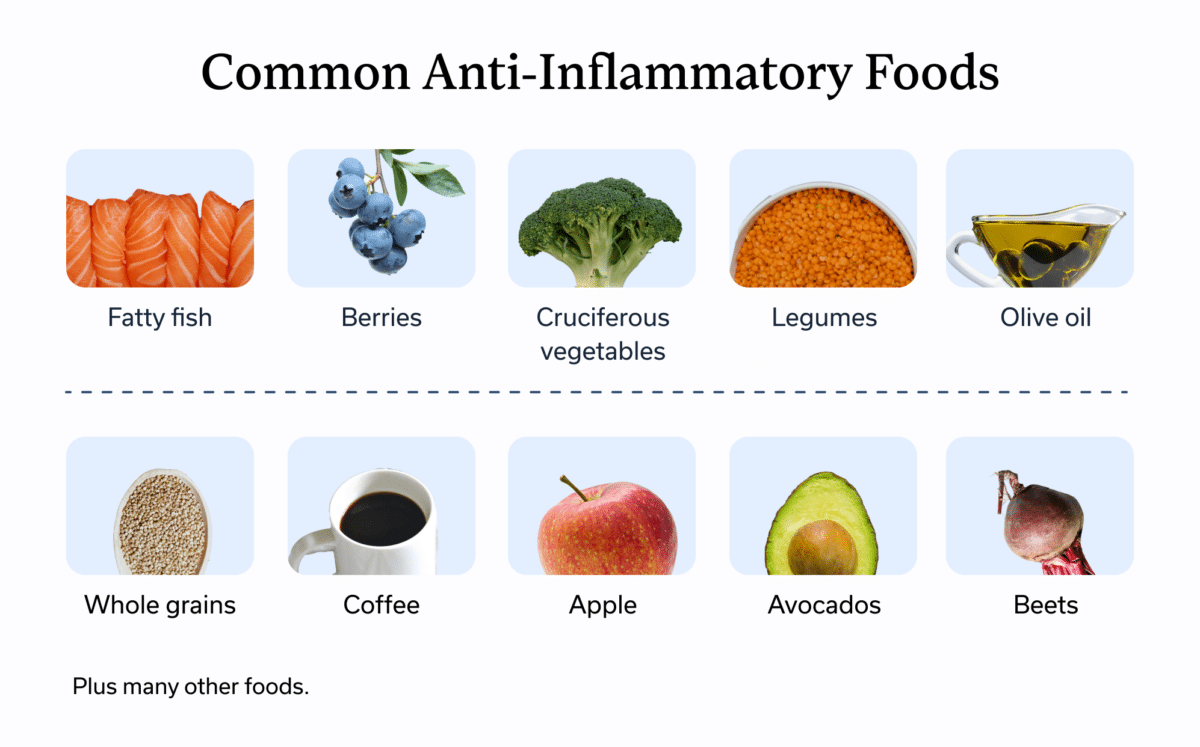
- Alliums, such as leeks, onions, and garlic
葱属植物,如韭葱、洋葱和大蒜 - Apples 苹果
- Avocados, which have a host of healthy fats
鳄梨含有大量健康脂肪 - Beets 甜菜
- Berries 浆果
- Celery 芹菜
- Cherries 樱桃
- Citrus fruits, such as grapefruit, orange, lemon, lime, and more
柑橘类水果,如葡萄柚、橙子、柠檬、青柠等 - Coffee and tea 咖啡和茶
- Cruciferous vegetables, such as broccoli, cauliflower, Brussels sprouts, kale, arugula, bok choy, cabbage, and more
十字花科蔬菜,如西兰花、花椰菜、球芽甘蓝、羽衣甘蓝、芝麻菜、白菜、卷心菜等 - Dark chocolate—the darker, the better
黑巧克力——越深越好 - Fatty fish, such as salmon, sardines, mackerel, and anchovies
肥鱼,如三文鱼、沙丁鱼、鲭鱼和凤尾鱼 - Green leafy vegetables, such as kale, chard, spinach, arugula, and more
绿叶蔬菜,如羽衣甘蓝、甜菜、菠菜、芝麻菜等 - Herbs, such as thyme and parsley
草药,如百里香和欧芹 - Legumes, such as lentils and beans
豆类,如扁豆和豆类 - Mushrooms 蘑菇
- Nuts and seeds (aim for raw, rather than roasted) such as almonds, Brazil nuts, walnuts, chia, flaxseeds, pumpkin, and basil seeds
坚果和种子(尽量选择生食而非烤制),如杏仁、巴西坚果、核桃、奇亚籽、亚麻籽、南瓜和罗勒籽 - Olive oil 橄榄油
- Orange vegetables, such as carrots and squash
橙色蔬菜,如胡萝卜和南瓜 - Peppers—all kinds, including the hot ones
辣椒——各种辣椒,包括辣的 - Purple vegetables, such as eggplant, cabbage, carrots, potatoes, and more
紫色蔬菜,如茄子、卷心菜、胡萝卜、土豆等 - Root vegetables, such as parsnips, turnips, Jerusalem artichokes, sweet potatoes, yams, rutabaga, fennel, and more.
根茎类蔬菜,如欧洲防风、芜菁、耶路撒冷洋蓟、红薯、山药、芜菁、茴香等。 - Spices, such as ginger, turmeric, and cinnamon
香料,如姜、姜黄和肉桂 - Tomatoes 番茄
- Whole grains, such as millet, quinoa, oats, farrow, barley, and black, red, brown, and wild rice
全谷物,如小米、藜麦、燕麦、小麦、大麦,以及黑米、红米、棕米和野米
Are your habits hurting your gut health?
你的习惯是否正在损害肠道健康?
Your gut responds to more than just what you eat. Take this quick quiz to find out if your daily routines are helping—or quietly working against—healthy digestion. 🕵️♂️
你的肠道反应不仅仅是你吃了什么。做这个快速测验,看看你的日常习惯是否在帮助——还是悄悄阻碍——健康的消化。🕵️♂️Next 下一个
Tips for building an anti-inflammatory diet
建立抗炎饮食的建议
Now that you know which foods are packed with anti-inflammatory compounds and other benefits, you may wish to include more of them in your diet. Here are a few tips to consider when revamping your nutrition, especially if you have a GI condition.
既然你已经知道哪些食物富含抗炎成分和其他益处,你可能想在饮食中加入更多它们。以下是一些建议,尤其是在调整营养时,尤其是你有胃肠疾病时。
Focus on whole foods 专注于全食物
Anti-inflammatory nutrition plans include foods in their whole or original form, or as close to their original form as possible. This means you should load up your shopping cart with actual fruits and veggies, rather than, say, fruit juices or veggie chips. You can still cook your whole foods as needed.
抗炎营养计划包括食物的整体或原始形式 , 或尽可能接近原始形态的食物。这意味着你应该把购物车装满真正的水果和蔬菜,而不是比如果汁或蔬菜片。你仍然可以根据需要烹饪全食物。
Watch out for trigger foods
注意诱发食物
If you’re opting for an anti-inflammatory diet and managing a GI condition, such as irritable bowel syndrome (IBS) or inflammatory bowel disease (IBD), you may have certain food intolerances, or certain foods may trigger your symptoms. For example, if you have gastroesophageal reflux disease (GERD), spicy peppers, although anti-inflammatory, might be on your red-flag list.
如果你选择抗炎饮食并管理肠胃疾病,如肠易激综合征(IBS) 或炎症性肠病(IBD), 你可能有某些食物不耐受,或者某些食物可能引发你的症状 。例如,如果你患有胃食管反流病 (GERD),辣椒虽然具有抗炎作用,但可能在你的红旗清单上。